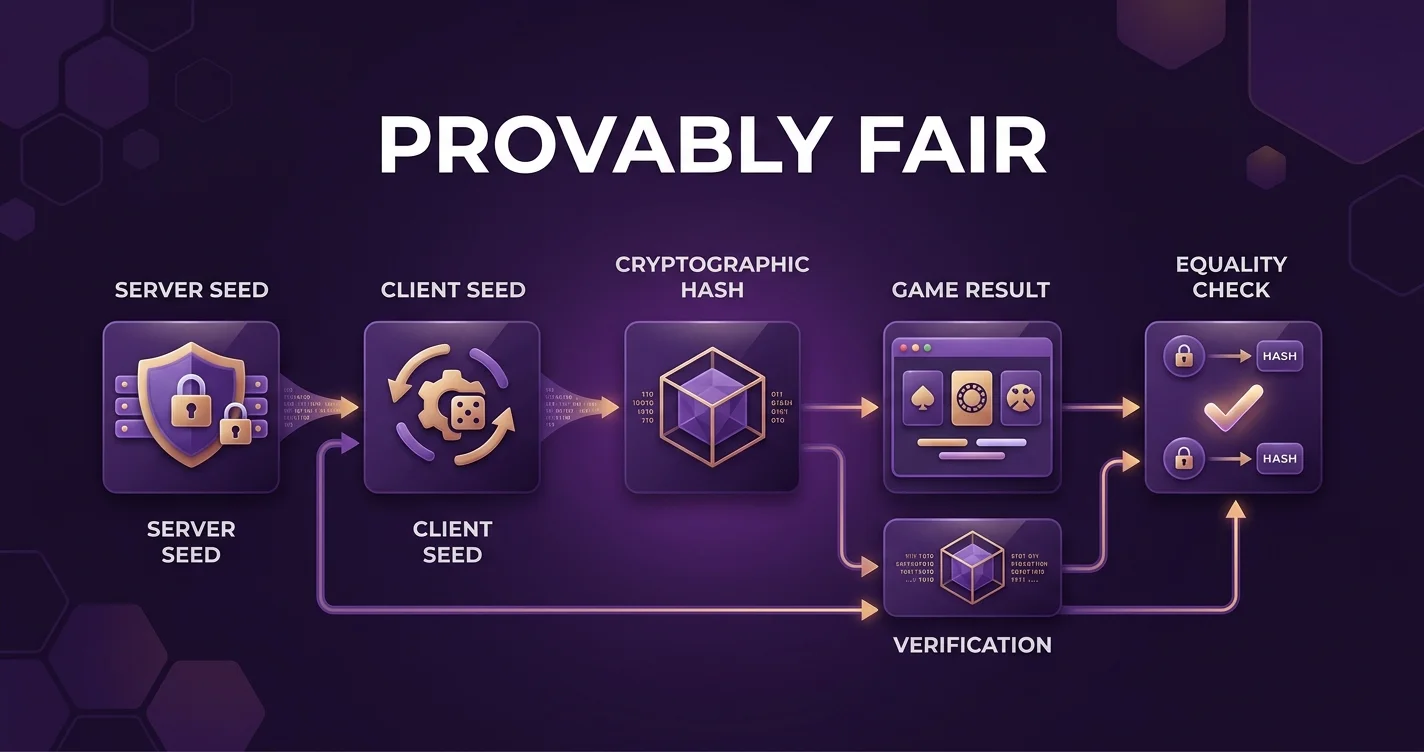
Provably Fair ("provably fair play") is a technology that lets players check for themselves that a round's result wasn't changed after the bet was placed. It relies on cryptographic hashes: the casino commits to a random value before the game, and afterwards you can confirm that the result really follows from it.
One thing to be clear about from the start: Provably Fair proves the fairness of the result calculation, but it does not make the game profitable. The odds and the house edge don't go anywhere.
Why it was invented
In a traditional online game, the player sees only the outcome: a card, a number or a multiplier. How it was generated is visible only on the server side. Trust is usually provided by a random number generator (RNG) and independent certification, but the player can't verify anything personally.
Provably Fair changes the approach: "trust us" becomes "check for yourself." This model is most often used in crypto casinos and in simple fast-round games: dice, crash, mines, plinko, coin flip.
What the system consists of
Almost every implementation has four elements.
- Server seed: a secret string generated by the casino. It is not shown during play.
- Server seed hash: a "fingerprint" of that string, visible to the player before the game starts. The hash can't be used to recover the string itself, but it can be compared against the string later.
- Client seed: the player's own string. You can leave the default or set your own.
- Nonce: a bet counter. The first bet has nonce 0, the second 1, the third 2, and so on. It makes every round produce a different result even though the seeds stay the same.
How it works step by step
- The casino generates a server seed and shows you its hash. It's like a sealed envelope: you can't see what's inside, but it can't be swapped later because the hash wouldn't match.
- You see or set your client seed.
- For each bet, the server takes the server seed, the client seed and the nonce and runs them through a hash function (most often SHA-256 or an HMAC based on it).
- A number is derived from the resulting hash using a public formula. That number determines the outcome: a dice roll, a multiplier or the placement of mines.
- When you change your seed or end a series, the casino reveals the old server seed.
- You verify two things: whether the hash of the revealed seed matches the one shown at the start, and whether the results of your bets can be reproduced with the formula.
Why is a client seed needed? The casino committed to its server seed before you chose yours, so it can't pick a "convenient" result for your string. And you can't predict the result because you don't know the server seed.
An example with simple numbers
Let's look at a simplified dice game. This is a hypothetical example; the values are not taken from a real system.
- The game produces a number from 0 to 99.99.
- You bet 100 UAH on "under 50."
- A win pays x1.98 of the stake.
The formula for converting the hash into a number is public. Say you take the first few characters of the hash, convert them to a decimal number, divide by the maximum possible value and multiply by 100. Suppose the result is 37.21. That is below 50, so the bet wins: you receive 198 UAH, a net profit of 98 UAH.
After you change the seed, you get the revealed server seed. You calculate the hash yourself (or with a third-party verification calculator) for the same pair of seeds and nonce. If you get 37.21, the result is genuine. If the number is different, that's a serious reason to contact support.
What about the house edge?
In this example, the chance of winning is 50% and the payout is x1.98. Let's calculate the expected value for a 100 UAH bet:
- 50% of the time you receive 198 UAH, which averages 99 UAH.
- The rest of the time you get nothing, i.e. 0 UAH.
- Average return: 99 UAH out of 100.
So on average the casino keeps 1 UAH out of 100 (1%). This is the house edge. Provably Fair doesn't remove that 1%; it only guarantees that the dice are rolled by the stated rules. The difference between "fair" and "profitable" is fundamental.
What Provably Fair proves and what it doesn't
| Proves | Doesn't prove |
|---|---|
| The round's result wasn't changed after your bet | That you will win more often or more |
| The result was calculated from the seeds you saw | That the stated payout is favorable: that's a matter of the house edge and the paytable |
| The casino didn't tailor the server seed to your client seed | That withdrawals will be quick and trouble-free |
| You can verify any past round | That the whole game is fair if the formula hides tricks in its settings |
Common mistakes and myths
"Provably Fair guarantees a win"
No. This technology is about verification, not odds. A long losing streak is just as possible in a fair game. Over the long run, the expected result always depends on the stated house edge.
"If you know the hash, you can predict the result"
No. The server seed hash is only a fingerprint. Recovering the secret string from it is practically impossible, and without that string you can't calculate the result.
"Your own client seed makes the game more profitable"
No. It changes the specific numbers but not the odds. The point of a client seed is only that you take part in shaping the result. There is no such thing as a "lucky seed."
"I don't verify, but I already trust"
This is the most common problem. If you never compare hashes, the technology gives you nothing. Verifying at least a few rounds is worthwhile, and if you have any suspicion, it's essential.
"Anything labeled Provably Fair is automatically fair"
No. A label is no substitute for a critical eye. Check whether the formula is public, whether you can change the client seed, whether old server seeds are revealed, and whether there is a third-party environment for verification.
"Every game has it"
No. In slots from studio developers, the result is usually determined by a certified RNG on the server side, and the player can't reproduce a round on their own. In live games with a real dealer, the result depends on physical events at the table. Provably Fair is most often found in simple "fast" games.
How to use it in practice
- Find the verification section. A game with this feature usually has a "Fairness" or "Verification" menu. There you can see the server seed hash, the client seed and the nonce.
- Write down the hash before the series starts. That way you can reliably compare it with what the casino reveals later.
- Change the client seed to your own. It takes a second and adds your input to the result.
- After changing the seed, verify a few rounds. Use an independent calculator or your own script, not just the casino's built-in button.
- Check the paytable separately. Calculate the house edge built into the game, just as in the example above.
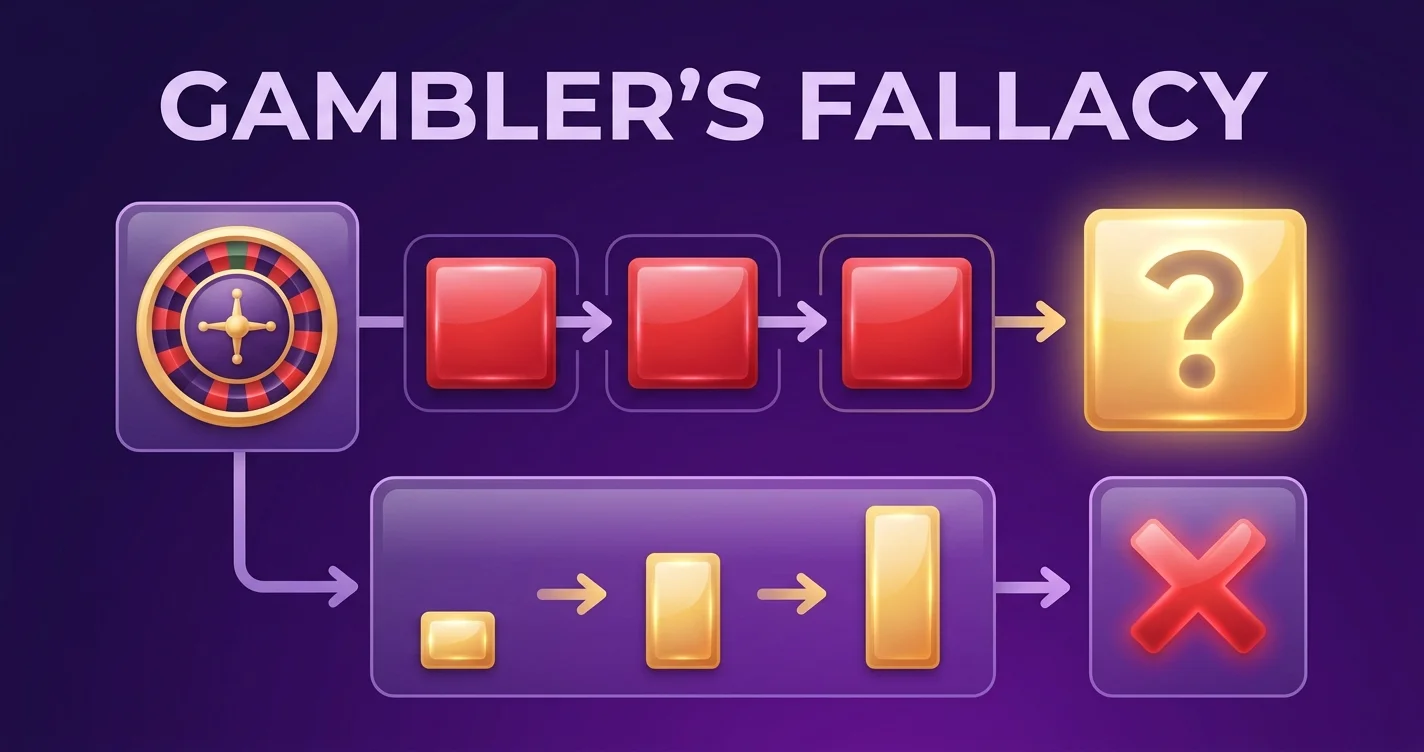
- Don't change the seed in the middle of a "losing streak" hoping to change your luck. It won't affect the odds and will only muddle your statistics.
How this affects your choice of game
For a player, Provably Fair is a plus for transparency, but not the only criterion. Look at a combination of factors:
- what the house edge is in the chosen game;
- whether the rules and payouts are clear;
- whether you can verify the results yourself;
- whether deposits and withdrawals work transparently;
- whether the pace of play is comfortable for you.
A game with fast rounds and transparent verification is still gambling. Fast rounds easily eat through a budget, so decide in advance how much you are willing to spend and don't exceed it. Also, don't try to "win it back."
Responsible gaming
Technical fairness doesn't remove the risk of losses. You must be 18 or older to play, and you should only play with money you can afford to lose. If you feel the game is getting out of control, use the limiting tools. For example, RichTop offers self-exclusion from 6 months to 5 years, and tips on keeping your play under control are collected in a separate guide.
In brief
- Provably Fair lets you check for yourself that a round's result wasn't changed after the bet.
- The basis: a server seed with its hash, a client seed and a nonce.
- The technology proves the fairness of the calculation, but not that the game is profitable, and it doesn't guarantee a win.
- It's useful to change your client seed and actually verify rounds instead of simply trusting the label.
- Assess the house edge and payouts separately.





 Google

 Payment History